Your app. Our diagnostics.
Live in weeks, not quarters.
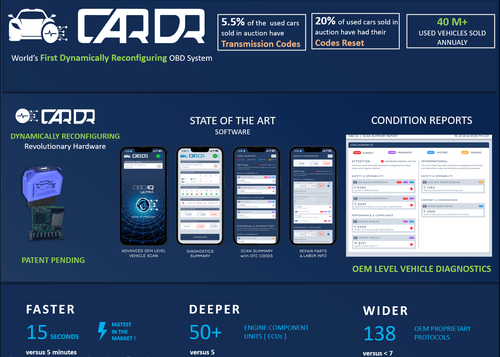
CarDr gives automotive platforms two ways in: cloud APIs that need no hardware at all, and the patented ULTRA adapter plus mobile SDKs for full 60-second, 138+ protocol vehicle scans. Pick the integration depth that fits your roadmap — from a branded app you ship tomorrow to a fully embedded SDK inside your own product.
Cloud-only data, or full hardware-powered diagnostics.
Built for DMS providers, auction platforms, inspection apps, warranty administrators, and fleet software teams. Start with one pathway and add the other later — they share the same data model and the same report engine.
Cloud APIs — no OBD device required
Power your platform with real-time vehicle intelligence using nothing but a VIN and fault codes you already collect. Ideal for DMS platforms, auctions, and mobile apps that want insight without shipping devices.
- VIN Decode — make, model, year, trim, engine and more from a VIN.
- DTC Lookup — plain-English decoding, including OEM-specific P/B/C/U codes.
- PCF (Potential Component Failure) — AI-predicted failures before they happen.
- Code Reset Detection — identify DTCs recently cleared to mask issues.
- Repair Cost Estimation — real-world parts and labor bands per fault.
- Emissions Readiness & History — will the vehicle pass inspection.
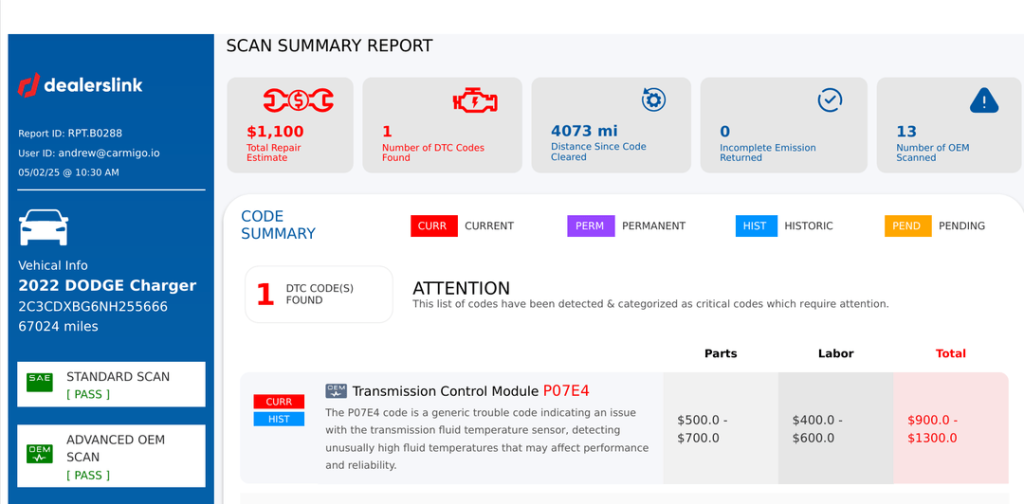
- Condition Report API — generate and embed a branded diagnostic report.
Use cases: appraisals, post-sale inspection, warranty underwriting, mobile diagnostics, DMS plug-ins.
ULTRA adapter + SDK — deepest OBD integration available
Tap the full power of dynamically reconfiguring OBD diagnostics with the patented ULTRA adapter and developer-friendly mobile SDKs.
- 60-second full vehicle scan — the fastest in the market.
- Dynamic GPIO reconfiguration — pin configuration matched to each make/model.
- 138+ OEM protocols — covering 90%+ of vehicles on the road.
- 50+ ECUs accessed — powertrain, transmission, ABS, airbag and more.
- Advanced DTC detection — hidden codes static scanners miss.
- Live OTA protocol updates — delivered from the cloud, no firmware recalls.
- Detailed scan outputs — safety recalls, repair costs, photos, history flags.
Ideal for: auction inspections, reconditioning centers, dealer networks, international inspection platforms.
Four levels of integration. Ship at any of them.
Most partners go live at Level 1 or 2 within days, then deepen to Level 3 or 4 once volume justifies it. Nothing is thrown away when you move up a level.
No Integration
Use the OBDIQ app for iOS and Android carrying your logo, with diagnostic report links branded for your business. Nothing to build.
Minimal Integration
Your logo inside the app, plus branded diagnostic reports delivered to your team through secure, shareable links.
Partial Integration
Use URL-based APIs to fetch scan data or embed a completed diagnostic report inside your own platform's UI.
Full Integration
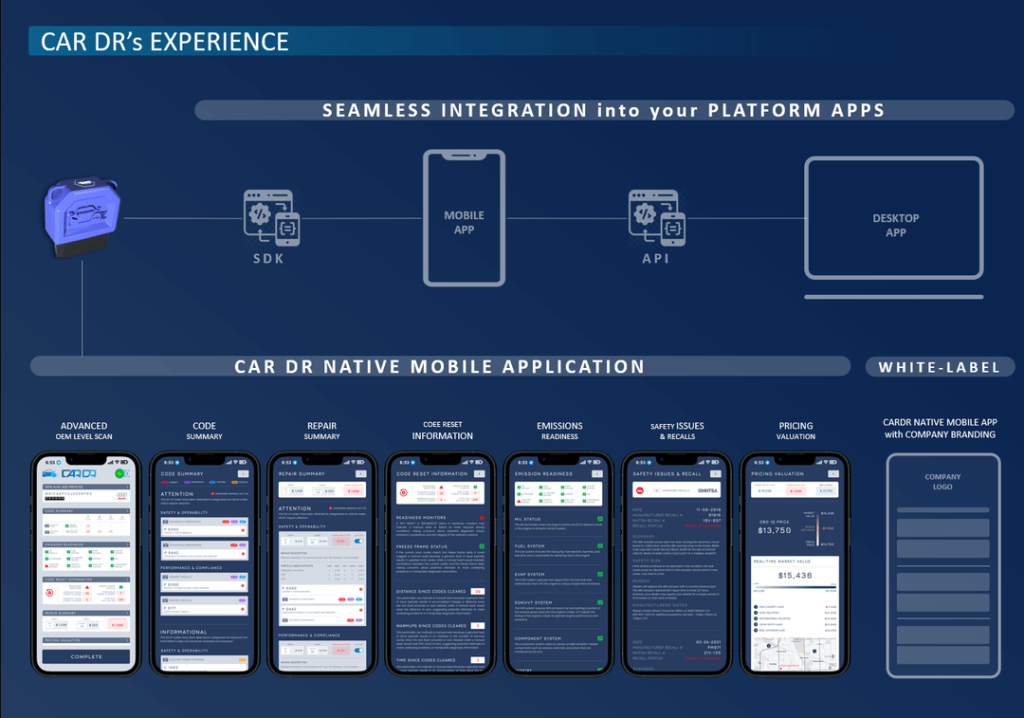
Embed the iOS, Android or React Native SDK plus the RESTful APIs for a deep, seamless, fully white-labeled experience.
Timelines reflect typical partner deployments and are confirmed during integration scoping.
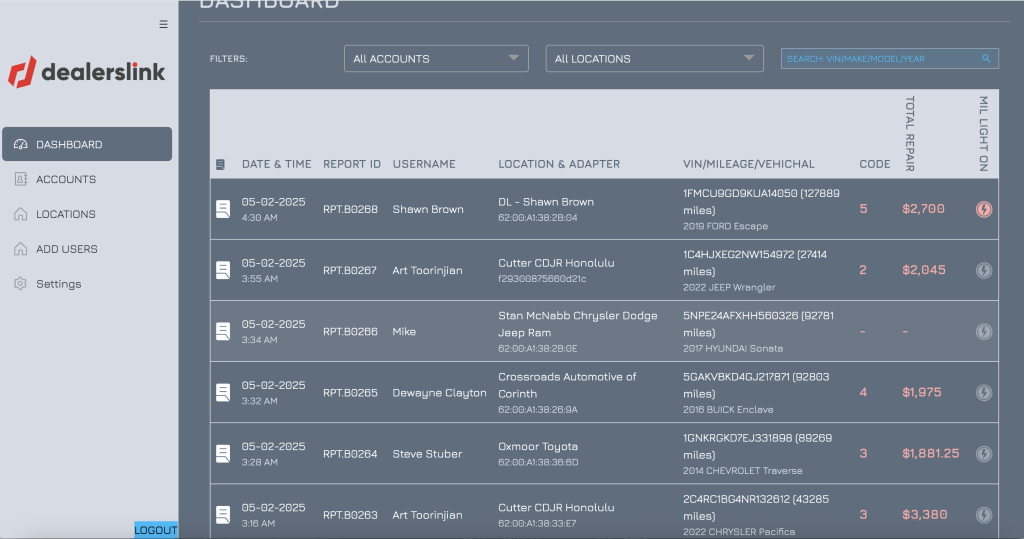
See it integrated: Dealerslink.
Dealerslink, a third-party dealer platform, integrated CarDr diagnostics into its own product. This walkthrough shows what a live partner integration looks like end to end — scan trigger, decoded results, and the report landing inside the partner's workflow.
Video courtesy of Dealerslink, a CarDr integration partner.
What your team should pick.
| If you are… | Start with | Because |
|---|---|---|
| A DMS or appraisal platform | Cloud APIs | You already capture VIN and codes — decode, price, and report without shipping hardware. |
| An auction or inspection network | ULTRA + SDK | Hidden codes and recent resets only surface with a deep, device-driven scan. |
| A warranty administrator | Cloud APIs → SDK | Start with pre-claim decoding and cost estimation; add scans where fraud risk is highest. |
| A fleet maintenance provider | ULTRA + SDK | Emission readiness, reset detection and live PID streaming keep vehicles out of downtime. |
| A dealer group with an existing app | Embedded SDK | Scan trigger drops into the workflow your staff already uses, under your brand. |
White-label adapters, ready to deploy.
Partners can deploy CarDr's OBD hardware under their own brand, paired with SDK-triggered scans and API-delivered data — one vendor relationship, end to end.
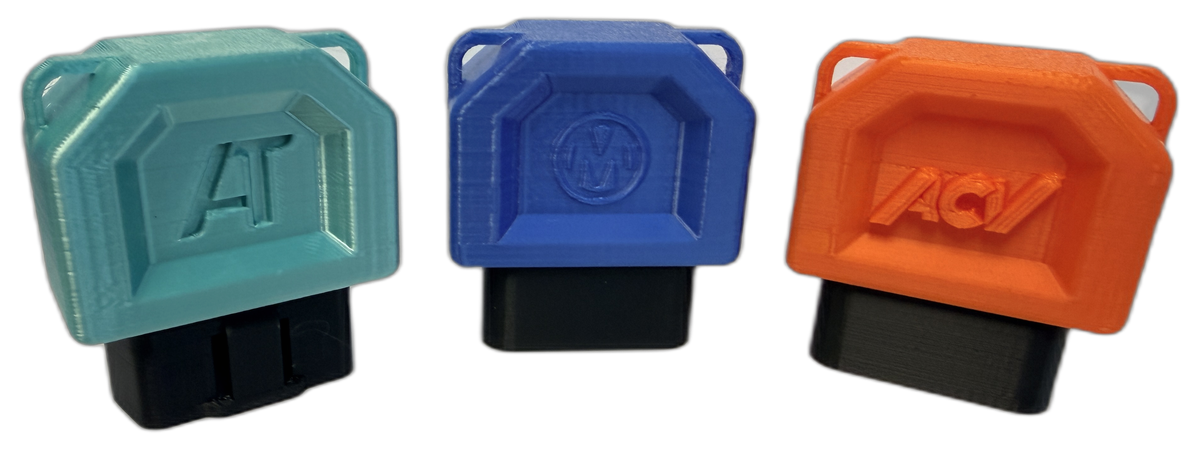
Custom-branded housings, produced for partner deployments.
For illustration purposes only.
Endpoints, payloads, and SDK commands.
Everything below is what your engineers will actually call. Full API documentation, sandbox keys, and SDK packages are issued at kickoff.
Cloud endpoints
GET /api/v1/vin-decode?vin=1HGCM82633A123456
Response 200 — application/json

{
  "make":   "Honda",
  "model":  "Accord",
  "year":   2003,
  "engine": "2.4L I4 DOHC 16V",
  "trim":   "EX"
}
GET /api/v1/dtc-lookup?code=P0100
Response 200 — application/json

{
  "code": "P0100",
  "description": "Mass air flow (MAF) sensor / volume air flow (VAF)
                  sensor circuit malfunction"
}
GET /api/v1/pcf?vin={vin}&code=C212A
Response 200 — application/json

{
  "dtcCode": "C212A",
  "module": "Anti-Lock Brakes Module",
  "status": "CONFIRMED HISTORY",
  "category": "Attention",
  "sub_category": "Other & Non Categorized",
  "criticality": "MEDIUM",
  "commonality": "Common",
  "description": "The vehicle's computer is not receiving a signal from
                  the wheel speed sensor, which can affect the ABS system.",
  "impact": "If not addressed, the ABS system may not function properly,
             leading to potential safety issues during braking.",
  "parts": ["Wheel Speed Sensor", "Wiring Harness"],
  "partsQty": 2,
  "partsCost": "$150 - $250",
  "laborHrs": "1.5 - 2.5 hours",
  "laborCost": "$150 - $250",
  "repairDeduction": "$300 - $500",
  "is_include": true
}
POST /api/v1/report
Request — application/json

{
  "vin": "3FAHP0HA2AR123456",
  "dtc_codes": ["P0420", "U0101"],
  "mileage": "32547",
  "logo_url": "https://partner.com/logo.png"
}
Scan commands (Android & iOS)
The SDK handles adapter pairing, protocol negotiation and result normalization. Your app calls a handful of methods.
| Method | What it does | Typical use case |
|---|---|---|
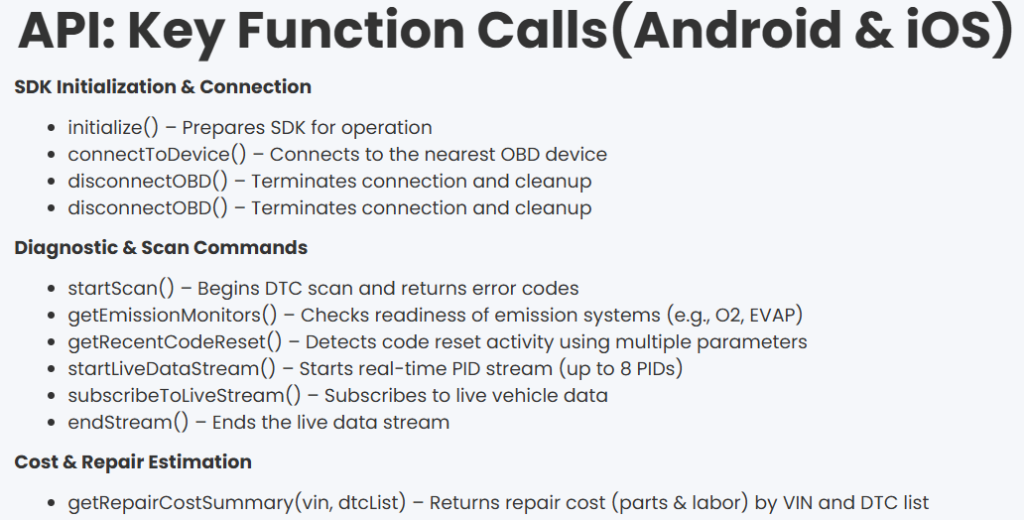
connectToDevice() |
Pairs the app with the ULTRA adapter and negotiates the correct protocol for the connected vehicle. | Called once at the start of every inspection session. |
startScan() |
Runs a full diagnostic scan of onboard systems and returns a structured list of current, pending, historic and permanent DTCs. | A dealership app triggers this at vehicle intake to identify faults and classify criticality immediately. |
getEmissionMonitors() |
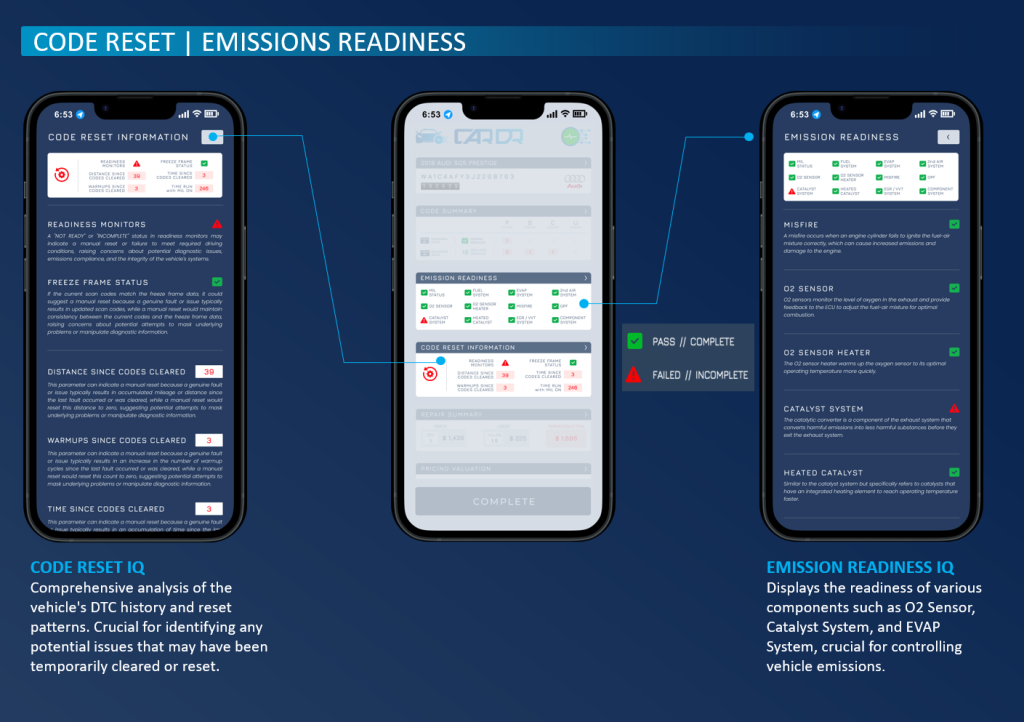
Returns readiness state of emission-related components — O2 sensor, catalytic converter, EVAP system and more. | An auction platform filters emission-compliant inventory by state automatically. |
getRecentCodeReset() |
Flags whether DTCs were recently cleared, reporting mileage, warm-up cycles and runtime since the last reset. | An appraisal app alerts buyers to potential tampering before purchase. |
startLiveDataStream() |
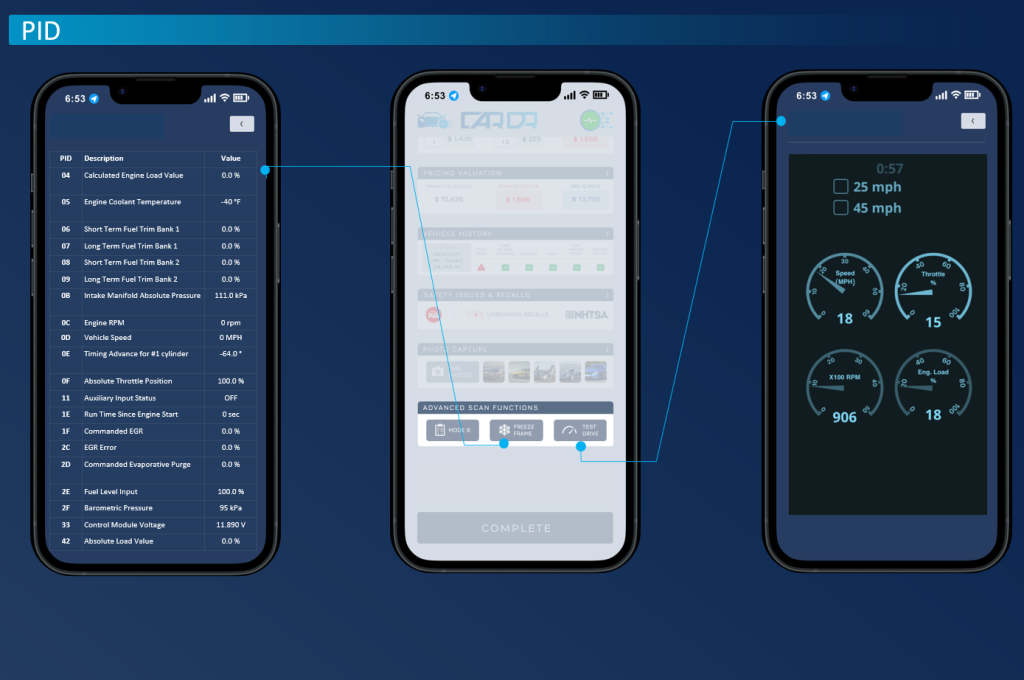
Begins live telemetry from up to 8 selected PIDs — RPM, coolant temperature, throttle position, fuel trims and more. | A mobile repair app diagnoses intermittent issues during a road test. |
subscribeToLiveStream() |
Listens for and acts on live data packets while the stream is running. | Fleet maintenance software tracks engine performance across many vehicles. |
endStream() |
Terminates the live diagnostic session cleanly. | Closes the session after a test drive or diagnostic run. |
getRepairCostSummary(vin, dtcList) |
Generates a region-aware, VIN-matched repair estimate per fault, broken down into parts and labor. | A DMS shows estimated reconditioning cost for trade-ins and auction purchases instantly. |
Available for iOS, Android and React Native. Method names are stable across all three SDKs.
The same SDK, four different products.
Diagnostic intelligence at trade-in
Dealers taking trade-ins or buying at auction are exposed to undisclosed issues, hidden resets and under-the-hood damage. Read the VIN with connectToDevice() and startScan(), decode the DTCs, translate them into plain English with repair recommendations, and price them with getRepairCostSummary().
Problem solved: no more relying on surface-level visual inspection or vague third-party tools.
From VIN to action, before failure
Most fleet apps stop at basic OBD scans. Use getRecentCodeReset() to find cleared codes, getEmissionMonitors() to confirm road and EPA compliance, and log every scan for accountability and maintenance records.
Problem solved: fleets miss vehicles that look clean but were just reset. You help clients spot bad actors and service proactively.
Real-time telemetry with live PID streaming
The SDK isn't only static scans. startLiveDataStream() and subscribeToLiveStream() let your app monitor RPM, fuel trims, oxygen sensor readings and more — ideal for remote inspections, mobile mechanics, real-time health checks and performance monitoring.
Problem solved: snapshot data hides transient faults like overheating, misfires and throttle inconsistencies.
Detect tampered codes, flag unsafe cars
When auctions sell to dealers, trust is everything. Run instant scans with startScan(), detect tampering with getRecentCodeReset(), evaluate emissions with getEmissionMonitors(), and export reports built on getRepairCostSummary().
Problem solved: tampered vehicles and hidden issues slip through, creating arbitration exposure on both sides of the sale.
Raw codes in. A professional report out.
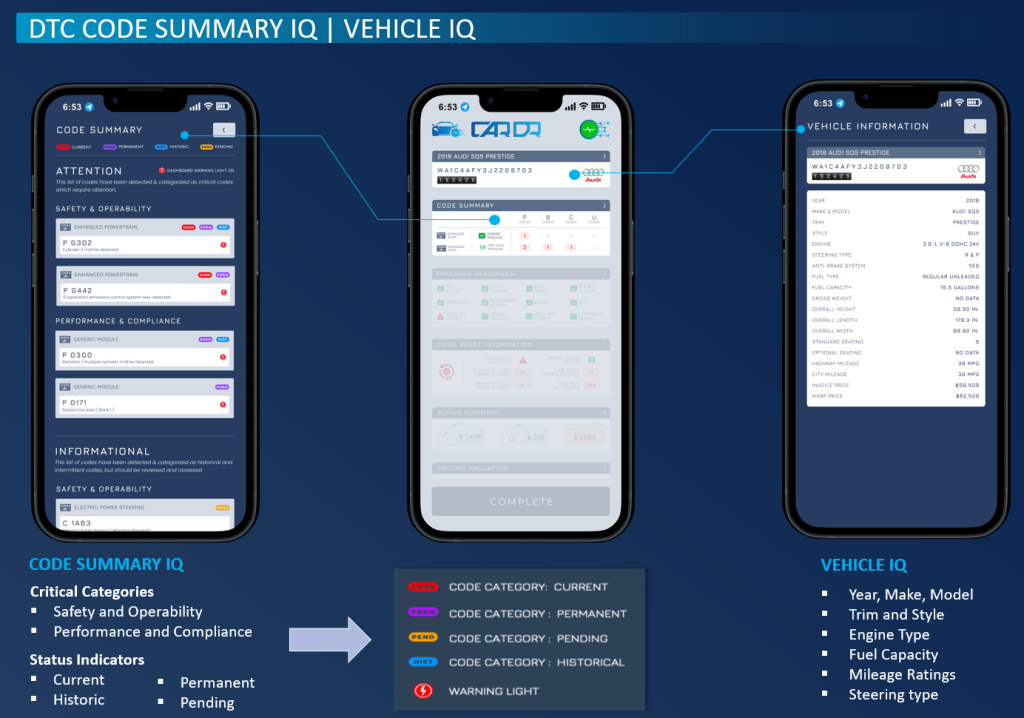
Most end users don't know what "P0420" or "C025E" means. The SDK turns fault codes into a formatted vehicle health report your customers can actually read and act on.
- VIN, DTCs, ECU names and severity
- Reset detection and Emission Readiness IQ
- Safety recall status
- Estimated repair costs, parts and labor
- Optional scan photo capture and full scan history
Shareable, branded, defensible
Equip your app with branded scan reports, build trust with dealerships, buyers, fleet partners and consumers, and offer full condition transparency at purchase or resale.
Four steps from first call to production.
Scoping call
Tell us how the scan should be triggered and where the data needs to land. We recommend an integration level.
Sandbox access
Your developers receive API keys, full documentation, and SDK packages for iOS, Android or React Native.
Pilot
Adapters ship to your test sites. We validate scan coverage, report branding and data mapping against your systems.
Production
Go live with OTA protocol updates, monitoring and ongoing developer support from the integration team.
Developer support & white-label partnerships
For integration planning, sandbox credentials, or white-label deployments, talk to the integration team directly.
sales@cardr.com · (800) 932-1120 · Sign up
Contact Sales